

The Ultimate Guide to Men's Hakama: History, Styles, and Modern Wearing Techniques
The Ultimate Guide to Men's Hakama: History, Styles, and Modern Wearing Techniques
Whether you have stepped into an aikido dojo, watched a Shinto wedding, or browsed streetwear lookbooks from Tokyo, you have likely noticed the striking silhouette of the hakama. This mens hakama guide covers everything you need to know - from centuries-old history and pleat symbolism to practical sizing, tying techniques, and modern styling tips.
Quick Overview: What Is a Men's Hakama?
A hakama is a traditional Japanese garment worn over a kimono, characterized by wide legs, deep pleats, and four straps called himo that secure the garment around the wearer's midsection. Think of it as traditional japanese pants with a dramatic, flowing silhouette that moves between trouser and skirt depending on the style. Unlike a standard formal kimono outfit, the full formal male ensemble combines a nagagi (long kimono), a hakama, and a haori (a sleeveless jacket or hip-length coat), often bearing family crests.
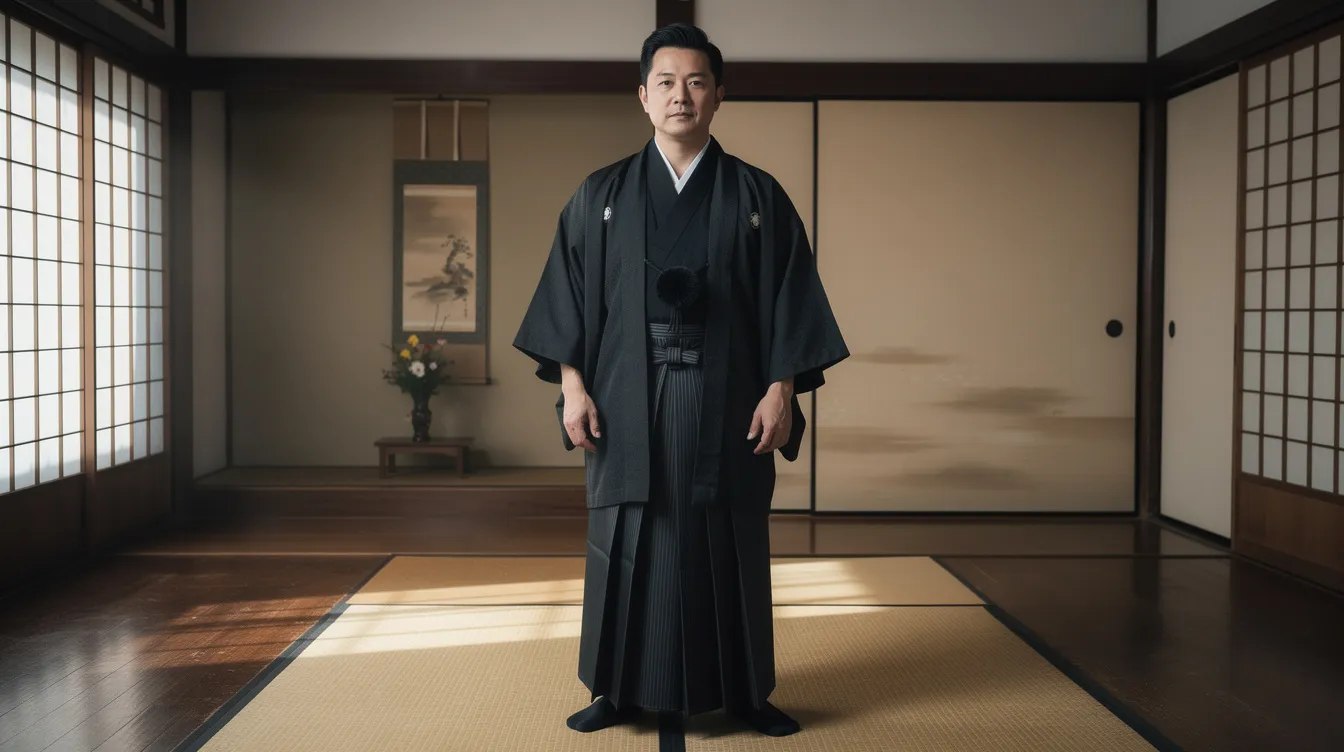
In modern times, hakama are mainly worn during ceremonies, martial arts, and traditional events. You will see them in aikido and kendo dojos, at Shinto weddings, and during graduation ceremonies across Japan. Picture a groom in 2020s Tokyo wearing a black montsuki kimono with a crisp striped hakama and matching haori - that is the pinnacle of men's formal wear in Japanese tradition.
This guide focuses on men's hakama specifically, though many principles - pleat symbolism, basic tying, fabric care - also apply when young women and women wear hakama for traditional japanese sports like kyūdō and aikido. Let's start at the beginning.
Historical Background: From Court Dress to Samurai Armor and Beyond
Hakama evolved from Chinese fashion and were adopted in Japan around the 6th century, initially as loose lower garments for aristocrats. By the Heian era (794–1185), hakama had become a codified part of court dress, with length, color, and layering signaling rank and occasion. Early forms like sashinuki hakama were designed to expose the foot, gathered at the ankles with cords, giving nobles freedom of movement beneath their layered robes.
Hakama originated in the Heian era but became common among the warrior class during the Kamakura period (1185–1333). Samurai needed garments that protected their legs while riding horses, so the divided umanori style gained traction as practical horseback riding gear. Hakama were originally designed for samurai to protect their legs while riding horses, and this functional origin shaped everything about the garment's cut and construction.
In the Edo period (1603–1868), hakama were standard clothing for samurai. Elaborate styles emerged: naga-bakama are long hakama worn in Noh plays and at formal court functions, trailing dramatically behind the wearer. Ōguchi-hakama are red underpants worn under uenobakama as part of layered ceremonial dress. Meanwhile, the field hakama (nobakama) served soldiers and rural workers with a tighter, more practical cut.
The Meiji period brought sweeping Westernization. Suits replaced hakama in everyday life, but the garment survived in traditional clothing, Shinto religion, and performing arts. Hakama were traditionally worn by samurai during formal events, and that association with dignity carried forward even as daily use declined.
By the Taisho period, hakama became standard for female students, and hakama styles evolved to include forms for both men and women. The 20th century cemented hakama as a garment for special occasions - worn at weddings, shrine visits, and in martial arts traditions across Japan. Hakama have shifted from everyday wear to formal occasions and martial arts, but their cultural weight has only grown stronger.
Cultural Significance: Symbolism in Traditional Japanese Clothing
In pre-modern Japan, hakama served as a visible marker of status. Only samurai, scholars, priests, and nobles regularly wore them, and commoners were sometimes restricted from wearing hakama altogether. Hakama traditionally signify formality, martial arts discipline, and cultural heritage - a reputation that still shapes how people perceive the garment today. A man in a crested kimono and hakama commands immediate respect at any gathering.
Hakama are deeply woven into Japanese rites of passage. Boys wear hakama for Shichi-Go-San ceremonies at age five. Young men don them for Seijin Shiki (Coming-of-Age Day at twenty), and university students frequently wear them at graduation ceremonies in Japan. Hakama are worn by men at tea ceremony gatherings and weddings, reinforcing the garment's role as a bridge between personal milestones and cultural tradition.
In religious life, Shinto priests wear white or subdued hakama during rituals, and miko shrine maidens wear hakama during Shinto ceremonies - typically a red hakama over a white kimono. While this guide centers on men's wear, these ceremonial uses illustrate how central the garment remains to Japanese spiritual practice.
Within martial arts, the act of carefully folding and maintaining a hakama is itself a form of discipline. Practitioners learn that the garment is not merely clothing but a symbol of their commitment. For younger generations, wearing hakama at cultural events or incorporating them into modern fashion helps reconnect with traditional japanese heritage in a tangible, personal way.
Main Types of Men's Hakama: Divided vs. Undivided
Men's hakama styles vary by construction and formality, adapting to specific occasions. The two fundamental categories are divided (umanori) and undivided (andon), and choosing between them depends on how and where you plan to wear hakama.
Umanori hakama have divided legs for flexibility, resembling extremely wide pleated trousers with a central partition. This horse riding hakama design originated for mounted samurai and remains the standard for martial arts and active wear. The divided legs allow free foot movements, deep stances, and comfortable kneeling - essential in aikido, kendo, and kyudo hakama practice.
Andon hakama are undivided and resemble a dress or lantern hakama, with a single tube of fabric that flows freely around both legs. They appear in formal court traditions, theatrical performances, and some ceremonial contexts. Because there is no division between the legs, they create a smooth, elegant silhouette when the wearer stands still, but offer less practicality for vigorous movement.
Different styles of hakama include umanori, andon, and striped formal designs, along with specialized cuts for particular needs. Nobakama have a tighter cut and three folds for easier movement, favored historically by soldiers and field workers. Kyudo hakama are tailored for the archer's repeated kneeling and bowing, with neatly sewn inner pleats. Naga-bakama are long hakama worn in Noh plays, trailing behind the performer for dramatic effect.
When walking, the umanori's divided legs move independently, giving a trouser-like stride. The andon's undivided body swings as a single panel, creating a more flowing gait. For your first hakama, the umanori is almost always the practical choice - it works for martial arts, casual wear, and most formal occasions.
Anatomy of a Hakama: Pleats, Straps, and Structure
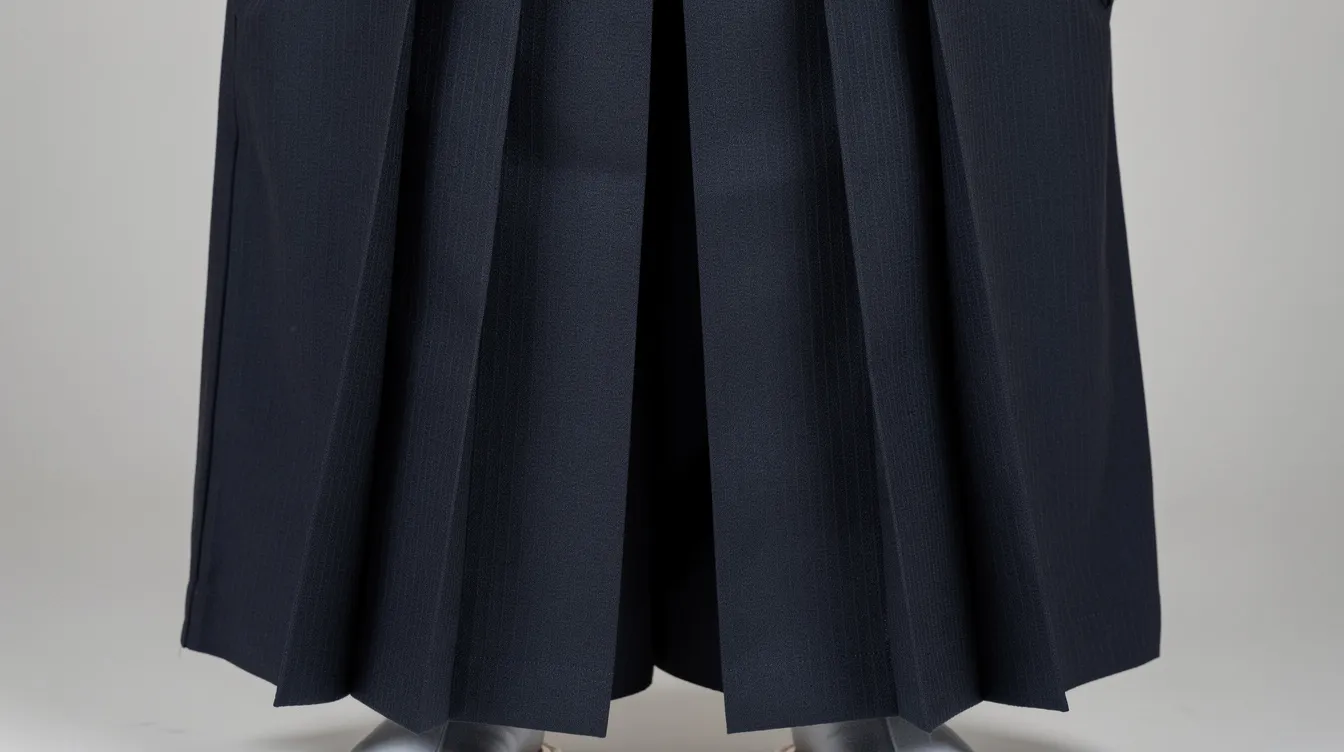
Every men's hakama, whether it is a cotton training garment or a silk ceremonial piece, shares the same core components: a pleated body, a koshiita (stiff backboard), and long himo (straps). Understanding these parts helps you evaluate quality, fit, and suitability before you buy your first pair.
The front pleats (mae-hida) are the most visually distinctive feature. Hakama typically feature seven pleats in aikido styles - five in front and two in back. In many martial arts traditions, each front pleat is taught to represent a bushido virtue: jin (benevolence), gi (righteousness), rei (courtesy), chi (wisdom), and shin (sincerity). The symbolism varies between dojos and schools, so treat these associations as living tradition rather than fixed doctrine.
The back pleats (uro-hida) number two and are sometimes interpreted as representing chūgi (loyalty) and meiyo (honor). Some instructors teach slightly different virtue assignments, and it is worth noting that this pleat symbolism may be a relatively modern overlay rather than an ancient rule.
Hakama typically feature a stiff backboard called koshi-ita to maintain structure and support the lower back. In martial arts hakama, the koshiita may be softer or rubber-lined to protect the spine during ukemi (falls). Formal and ceremonial hakama often use a rigid wooden or thick board koshiita for a sharper silhouette.
Hakama are secured using four straps called himo - two long front straps that wrap around the body and two shorter rear straps. The front belt straps must be long enough to circle the waist or hips, cross, and tie securely. Quality stitching at the strap attachment points is one of the clearest indicators of a well-made garment.
Other details worth noting include the hakama dome, a small tab or hook at the back that is tucked behind the obi for stability. Lateral vents at the sides allow access to items tucked into the obi, and inner stitched pleats help preserve shape in modern synthetic materials.
Materials and Fabric Choices: Cotton, Polyester, and Blends
The fabric of your hakama determines how it drapes, how much care it demands, and how long it lasts under regular use. Three main categories dominate the market.
Traditional hakama were made from aizome cotton - indigo-dyed, heavy, and rich in texture. A cotton hakama offers a dense drape and a satisfying weight that many martial artists and enthusiasts of traditional japanese clothing prefer. Aizome cotton, however, requires careful washing: cold water, separate cycles, and air drying away from direct sunlight. The dye will bleed noticeably during the first several washes.
Modern hakama often use Tetron, a polyester-rayon blend that has become the standard for daily practice. Tetron is three times cheaper and stronger than cotton, making it the most practical choice for anyone training three or more times per week. Polyester hakama resist wrinkles, dry quickly, and hold up well to regular washing - though they lack the traditional weight and subtle sheen of natural fibers.
Hakama can be made from polyester linen for lightweight comfort, a popular choice in Japan's humid summers. These blends breathe more freely than pure polyester and carry a slightly more textured, casual appearance. They work well for semi-formal uses and for practitioners who train in hot climates.
For martial artists maintaining a similar practice schedule of three to four sessions per week, synthetic materials outperform cotton in durability and ease of care. Cotton holds pleats better after proper pressing, but synthetics bounce back from wrinkles with minimal effort. Silk remains the gold standard for extremely formal occasions, offering unmatched luster, but is rarely practical for anything beyond weddings and ceremonies.
If you are choosing your first hakama for aikido equipment or another martial art, start with polyester or Tetron. As your commitment deepens, consider adding a high-quality cotton or silk piece for formal occasions and special events.
Sizing & Fit Guide: How to Choose the Right Men's Hakama Size
Hakama sizing relies primarily on one measurement: the distance from where you tie the garment to your outer ankle bone (lateral malleolus). Overall height matters less than this specific length, because where you position the hakama on your body shifts the fit significantly.
To measure, stand straight and have someone run a tape from the point where you plan to tie the hakama - typically the hip bones for men - straight down to the ankle bone. Record the number in centimeters. Men typically tie hakama at the hips, women at the waist, so your measurement starting point matters.
Many Japanese-made hakama use the traditional kujira-shaku system, where one unit equals approximately 3.79 cm. A size 27 hakama corresponds to roughly 102.3 cm from the upper edge of the front himo to the hem - suitable for many men around 170–175 cm in height. A size 26 comes in at about 98.5 cm, better for slightly shorter builds.
Formal hakama usually end just above the ankle for a clean, polished line. Some aikido hakama are worn slightly longer to create flowing visual movement during techniques. A long hakama can look dramatic, but anything past the ankle risks catching underfoot.
If you have a Western build with a broader waist or longer legs, pay attention to strap length. Some makers offer extended himo or wide-cut options. A 175 cm man wearing hakama at the hips versus at the waist might shift the recommended size by a full step - so always measure from your actual tying point, not from a generic chart.
How to Wear Hakama Over a Kimono or Yukata: Step-by-Step Basics
Men usually wear hakama over a regular kimono (nagagi) or sometimes a casual yukata, always secured first with a narrow kaku-obi or tsuke-obi. The obi sits beneath the hakama and provides the anchor point for the entire ensemble. A classic judo type belt is not appropriate here - you need a proper wide belt or kaku-obi that sits flat against the body.
Start by putting on your kimono with the left side over the right (right over left is reserved for the deceased - a critical cultural point). Tie your obi firmly at the waist, ensuring it sits flat without bunching. The obi should feel snug but not restrictive.
Step into the hakama legs if wearing umanori, or simply step into the opening for andon style. Lift the front panel to your midsection, positioning the upper edge of the front panel at or just below the obi. The front pleats should hang straight and even.
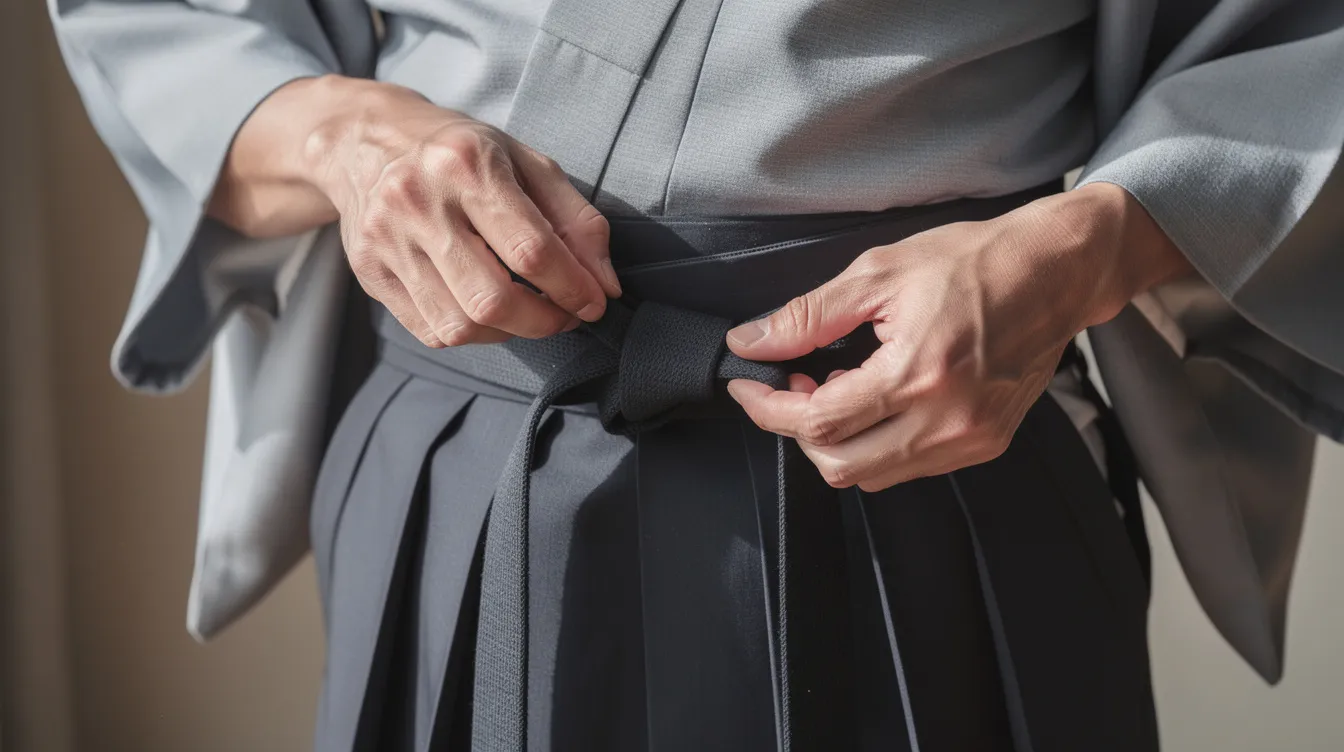
Take the two long front himo and wrap them around your body to the back, crossing them over the koshiita area, then bring them forward again. Tie them at the front below the front panel. The most formal tying method resembles two bow-ties in a cross shape, though many practitioners use a simpler bow knot or square knot for daily practice.
Now position the koshiita against your lower back, pressing it firmly above the obi knot. Take the two shorter rear himo, bring them forward around your sides, and tie them at the front. The right belt strap typically crosses over the left. Tuck the hakama-dome behind the obi for stability if your hakama has one.
Finally, smooth the front pleats so they fall in clean, even lines. Check that the hem sits at the same length on both sides - it should rest just above or at the ankle. In martial arts dojos, instructors often teach specific tying conventions for aikido hakama, kendo, or iaido hakama, so follow your teacher's hakama method once you join a class.
The key is patience. Rushing the tying process leads to twisted straps and uneven pleats. Take an extra minute, and the result will look - and feel - dramatically better.
Men's Hakama in Martial Arts: Aikido, Kendo, Iaido, and Kyudo
Hakama are integral to many Japanese martial arts, with specific cuts, weights, and details tailored to each discipline. Martial artists treat the hakama not just as a uniform but as an extension of their practice - a garment that demands the same care and attention as their technique.
In aikido, the hakama is typically dark navy or black. Aikido hakama generally have seven distinct pleats, and the garment is frequently worn with a reinforced koshiita to protect the spine during rolls and falls. Many aikido schools reserve the hakama for students who have reached shodan (first-degree black belt), while others allow beginners to wear hakama from day one. If you are purchasing your first pair for aikido equipment purposes, confirm your dojo's policy before buying. The highest ranking student in many dojos is sometimes tasked with demonstrating proper hakama folding and care.
Kendo and iaido hakama share a similar silhouette but are optimized for different foot movements. Kendo practitioners need clearance for rapid sliding steps (suriashi), so the front hem may sit slightly higher to prevent catching. An iaido hakama prioritizes smooth, controlled draws from seiza (kneeling), so the fabric needs to drape without interfering with the sword's path. Both are regularly worn in daily practice and are built from durable synthetic materials or heavy cotton.
A kyudo hakama is worn with a kyudo gi and obi, usually in the umanori style with precisely sewn inner pleats. The silhouette during the archer's shooting form - standing, drawing, and releasing - is considered part of the art itself. Kyudo demands an especially elegant line, so pleats must remain crisp and the hem must fall evenly.
Across other martial arts and traditional japanese sports, the training hakama prioritizes durability and freedom of movement. The garment is frequently worn in practice, sometimes daily, so synthetic materials dominate. But even a rugged training hakama maintains close ties to traditional Japanese aesthetics - the pleats, the straps, the disciplined folding ritual after each session.
Hakama for Formal Occasions: Weddings, Ceremonies, and Festivals
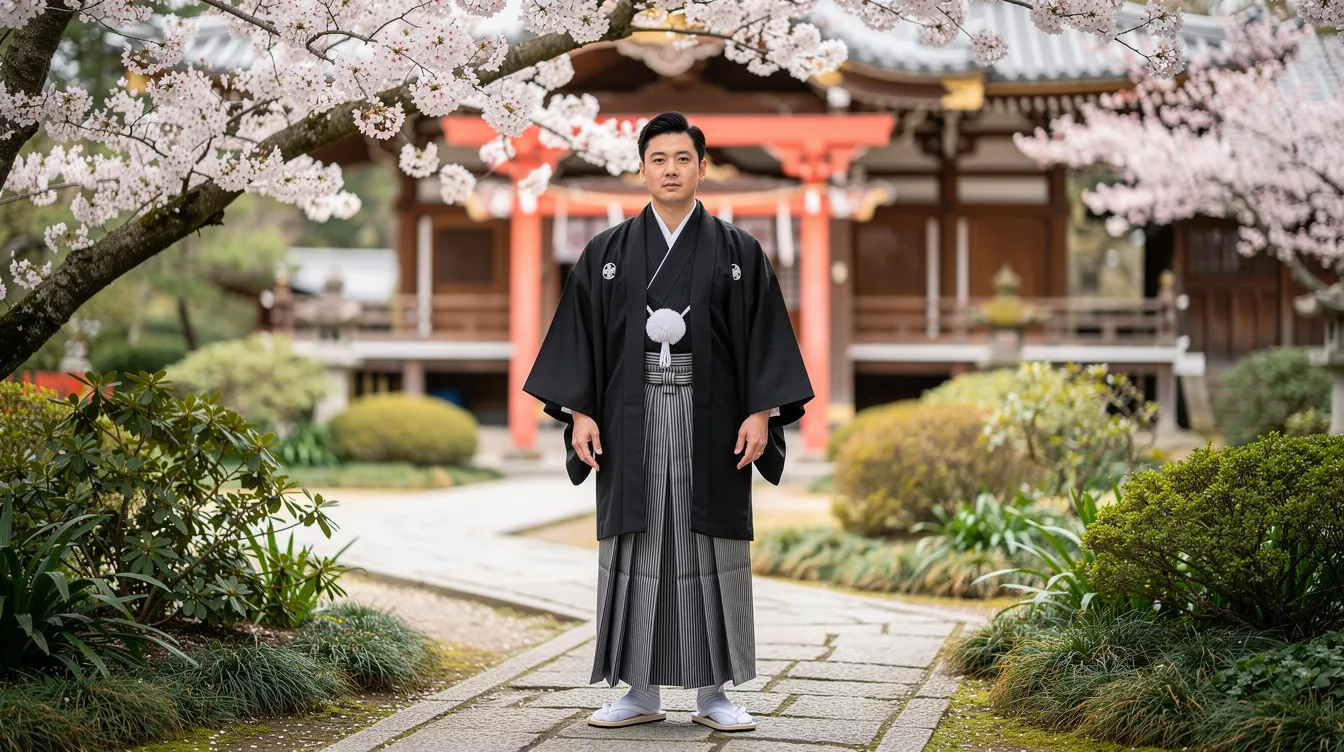
The most recognizable men's formal wear in Japan is the kuromontsuki haori hakama: a black montsuki kimono with five family crests, a matching haori jacket, and striped grey-and-black hakama. Striped formal hakama feature bold vertical stripes typically used for ceremonies, and this combination is worn at Shinto weddings, New Year shrine visits, and memorial services. Hakama are worn for formal events, traditional arts, and martial arts - but it is the formal context where the garment reaches its highest expression.
In contemporary Japan, men wear hakama at Shinto weddings as grooms and close family members. Coming-of-age ceremonies (Seijin Shiki) see young men in coordinated hakama and haori ensembles, and university graduation ceremonies remain one of the most visible occasions where traditional hakama appear in plain sight. Hakama are also worn at tea ceremony gatherings, where the flowing silhouette complements the ceremony's deliberate, meditative movements.
Color and pattern etiquette matters. For formal occasions, stick to subdued vertical stripes or solid neutrals - black, navy, charcoal grey. Brighter colors and bold patterns are reserved for festivals, stage performances, or fashion contexts. The number of family crests on the kimono and haori also signals formality: five crests for the most solemn events, three or one for semi-formal wear.
If you are a non-Japanese reader attending a formal event, coordinate your hakama color with your kimono and haori, wear white tabi socks with zori sandals, and keep accessories minimal. The difference between a ceremonial hakama and a martial arts one is significant - finer silk or wool fabric, more delicate finishing, and a cut that prioritizes appearance over rugged durability.
Modern Styling Ideas: Integrating Hakama into Contemporary Men's Fashion
Hakama are increasingly appearing beyond the dojo and shrine. In fashion-forward neighborhoods of Tokyo and Kyoto, younger men pair traditional hakama with casual tops, fitted jackets, and even boots - creating a look that blends traditional japanese clothing with contemporary streetwear.
Concrete combinations that work: a dark cotton hakama with a plain white shirt and a short haori-style jacket creates a clean, modern silhouette. For a more rugged, avant-garde look, try hakama with leather boots and a structured jacket. The key is proportion - wide hakama legs balance best with fitted or tailored tops. Avoid bulky layers above the waist, and keep patterns minimal to prevent a costume-like effect.
Modern hakama styling suits art openings, cultural festivals, themed photo shoots, and creative events where cherry blossoms, lanterns, or traditional architecture set the scene. Some wearers integrate hakama into casual wear for everyday life, though this works best in cities where creative dressing is the norm.
One important note: learn the correct terms, wear hakama neatly and with proper tying, and approach the garment with respect. Hakama are not disposable costumes - they carry centuries of meaning. Treating them with care, even in a fashion context, shows appreciation for the culture they represent.
Caring for Your Hakama: Washing, Drying, and Preserving Pleats
How you care for your hakama depends entirely on the fabric. Cotton and synthetic materials have fundamentally different needs, and treating one like the other will shorten the garment's life.
For aizome cotton hakama, wash separately in cold water for at least the first five to ten washes - the indigo dye will bleed significantly. Avoid long soaking, which accelerates fading. Hang dry in shade rather than direct sunlight. Never tumble dry cotton hakama; the heat causes shrinkage and damages the inner border stitching that holds pleats in place.
Polyester and Tetron hakama are far more forgiving. Machine wash on a gentle cycle, use cold or lukewarm water, and hang dry. Avoid high-heat ironing, which can melt or warp synthetic fibers. Most wrinkles in synthetic hakama relax on their own when hung properly.
To preserve pleats, smooth them by hand after every wear. For deeper resetting, lay the hakama flat on a clean surface, align each pleat carefully, and press gently with an iron set to low heat. Place a thin cloth between the iron and fabric to prevent shine marks. Re-setting pleats every few weeks keeps the silhouette sharp.
Store folded hakama flat on a shelf or hung by dedicated loops if your hakama has them. Avoid stuffing them into overcrowded drawers or closets where the koshiita board could warp. A large belt of fabric wrapped around the folded hakama can help maintain shape during storage.
How to Fold a Men's Hakama Properly
Folding hakama - called hakama-tatami - is considered part of martial arts etiquette and a sign of respect for traditional clothing. In some dojos, the teacher's hakama is folded by senior students as a way to practice correct technique and show humility.
First, spread the hakama front side up on a clean, flat surface - a tatami mat or large table works well. Smooth all five front pleats into alignment, pressing each one flat with dry hands. Next, flip the hakama over and align the two rear pleats, ensuring the koshiita sits flat and centered.
Fold both sides inward so the hakama forms a neat, narrow rectangle roughly the width of the koshiita. Then fold from the hem upward in two or three even stages, creating a compact bundle. Finally, arrange the four straps in a clean cross pattern on top of the folded body - some schools use a specific knot or wrap pattern for the himo.
Exact folding patterns vary between dojos, but the goals are universal: symmetrical folds, preserved pleats, and untangled straps. Practice this after every training session. Avoid rushed, careless folds that crush the koshiita or twist the himo - the garment remembers how you treat it.
Common Mistakes When You Wear Hakama (and How to Avoid Them)
Even experienced practitioners refine their hakama-wearing technique over years. Here are the most common beginner errors and how to fix them.
Straps tied too loosely. If the hakama slips during movement, the front belt himo are not tight enough. Double-check tension after tying - you should be able to fit one finger between the strap and your body, but no more. A large belt or obi beneath the hakama also provides an anchor point.
Hem too long. A hakama that drags on the floor is a tripping hazard, especially during surprise attacks drills or fast-paced kendo practice. Measure carefully before buying, and test by walking and kneeling before your first class.
Pleat misalignment. Front pleats that splay outward or bunch together look sloppy and restrict movement. Take thirty seconds after tying to straighten each pleat - this habit makes a visible difference.
Wrong kimono crossing. Always wrap left over right. Right over left is reserved for dressing the deceased in Japan. This applies whether you are wearing a regular kimono, yukata, or any base layer under your hakama.
Mismatched formality. Wearing a training hakama to a wedding, or pairing a formal silk hakama with sneakers, sends mixed signals. Match fabric and style to the occasion - a traditionally worn ensemble follows consistent formality from head to toe.
Mastery comes with repetition. Even practitioners who have been wearing hakama for decades occasionally adjust, re-tie, and refine. Treat each wearing as practice.
Conclusion: Choosing the Right Men's Hakama for Your Journey
The decisions come down to three fundamentals: purpose, fabric, and cut. If you are entering a dojo, a durable polyester umanori hakama is your starting point for aikido equipment or other martial arts. If you are attending a wedding or formal event, a silk or fine-wool traditional hakama with subtle stripes is the appropriate choice. And if you are exploring hakama as fashion, a solid-color cotton or blend in a muted tone gives you the most versatility.
Hakama connect modern wearers to centuries of Japanese culture while remaining thoroughly practical garments for movement, ceremony, and self-expression. They are worn today in dojos, shrines, wedding halls, and city streets - each context carrying its own meaning, but all sharing the same foundational respect for craft and tradition.
Start with one well-chosen hakama, learn to wear and fold it properly, and let curiosity guide you deeper. Whether your path leads to daily practice, a once-in-a-lifetime ceremony, or simply a new way of dressing, this mens hakama guide is your foundation.